A Résumé Ends
A résumé is usually created for an occasion. You want a particular job, so you select the parts of your experience that matter to a particular employer. Someone reads the document, makes a decision, and the transaction ends.
LinkedIn inherits much of the résumé’s vocabulary: employer, title, dates, education, skills. But it places that vocabulary inside something fundamentally different. Your profile persists even when you are applying for nothing, and it is available to an audience you did not assemble for one specific purpose. Coworkers, former coworkers, recruiters, clients, competitors, and people you have never met can all see the same professional self-portrait.
Around that profile is something the résumé never had: a feed.
Sarah was promoted. James founded a company. Maria completed an MBA. David spoke at a conference. Someone raised $10 million, joined Google, published a book, or was named to a list. Someone else is “thrilled to announce” the next recognizable change in professional status—and everyone else is watching.
The question is therefore no longer only, What should I tell this employer about my career? It becomes, What does a successful professional life look like when everyone can watch everyone else’s?
02 / The SampleThe Feed Is a Sample
Imagine trying to learn how good a person can become at piano by watching nothing but short-form videos. Everything you see may be real. That is precisely the problem: a medium does not need to show anything false in order to distort your sense of the whole. It only needs to select some parts of reality more consistently than others.
Short videos favor performances that can be understood quickly. What looks impressive on camera is more likely to be recorded; what fits the format is more likely to be distributed. Meanwhile, entire dimensions of musicianship may rarely appear—not because they do not exist, but because the medium has little use for them.
Eventually, the sample begins to look like the population. You stop seeing piano as represented by the medium and start believing you are simply seeing piano.
LinkedIn creates the same problem for professional life. Its feed is not a random sample of everything that happened to everyone professionally today. It is a sample of what happened that was LinkedIn-legible. Promotions, new jobs, degrees, funding rounds, launches, awards, and speaking engagements enter the feed easily. Other forms of development do not. The result is not necessarily false, but it is systematically incomplete.
03 / The State ChangeLinkedIn Sees the Promotion
Suppose you become a vice president. LinkedIn knows exactly what to do with that information: add the new title, attach it to a company, give it a start date, and notify your network.
Experience
The same clarity applies elsewhere. If you earned an MBA, there is an education field. If you received a certification, you can add the credential. If you launched a product, published a book, raised $10 million, or spoke at a conference, the platform gives you familiar ways to turn the event into a durable professional object.
LinkedIn understands these things well because they have properties software likes. They are discrete, nameable, attributable, and dateable. They can be associated with an organization, placed in a field, indexed in a search, and announced to other users.
What LinkedIn can see
Example Person
Senior Software Engineer
Example Company New York, NY · Contact infoExperience
- Senior Software EngineerExample Company · Full-timeSep 2023 – PresentNew York, NY
Education
- Example UniversityMaster of Business Administration2021 – 2023
Licenses & certifications
- Professional CertificationExample OrganizationIssued 2025
Company. Title. Degree. Certification. Award. Publication. Promotion. Each has a recognizable place.
Now suppose something else happened this year: you became much better at your job. Where does that go?
04 / The Blind SpotThere Is No Promotion for Judgment
An engineer may learn to recognize architectural problems six months before they become obvious, yet keep the same title. A manager may finally learn how to tell someone that their work is poor without humiliating them or destroying the relationship. A business leader may develop the judgment to distinguish a promising opportunity from an expensive distraction. An editor’s taste may improve so much that she can diagnose, in minutes, what previously took days to understand.
None of these changes necessarily produces a new credential, employer, or badge. Even years of disciplined private study can transform a person’s command of a field without creating anything new for the profile to record.
Try announcing the change directly: “I’m thrilled to announce that over the past eighteen months my judgment has quietly become considerably better.” It sounds absurd—not because the development is unimportant, but because neither the platform nor its professional dialect gives us a natural way to certify the claim.
I’m thrilled to announce that over the past eighteen months my judgment has quietly become considerably better.
That absurdity reveals the distinction: LinkedIn represents changes in professional state better than changes in professional substance.
State vs. Substance
Experience
Senior Software EngineerExample Company · Full-timeSep 2026 – PresentSoftware EngineerJun 2023 – Sep 2026Experience ManagerEmployee → ManagerEducation MBANo degree → MBALicenses & certifications CertifiedUncertified → CertifiedHonors & awards AwardNo award → Award
When an engineer becomes a senior engineer, LinkedIn sees it immediately. When someone remains a senior engineer but slowly develops exceptional engineering judgment, the change is much harder to represent.
Real expertise frequently develops without a defining event. Experience compounds. Mistakes teach. Patterns become recognizable. Knowledge becomes intuition. Problems that once required deliberate analysis begin to reveal their shape almost immediately. A person can become professionally unrecognizable while their profile remains nearly identical. The feed has no notification for that.
05 / The Non-EventGreat Work Sometimes Produces Nothing
The blind spot becomes stranger when expertise prevents an event from happening.
A security engineer prevents a breach. An executive declines a disastrous acquisition. A manager keeps an excellent employee from quitting. An engineer persuades the company not to spend a year rewriting a system that already works. A designer realizes that the requested feature should not exist. An investor passes on a seductive but terrible deal. An editor cuts the chapter that was weakening the entire book.
In each case, the professional creates value by making the visible outcome smaller. Sometimes nothing happens. Sometimes something disappears. The better the judgment, the less there may be to photograph, announce, or attach to a profile.
When expertise prevents an event
Path A — Good judgment
- Bad decision proposed
- Experienced person intervenes
- Bad decision abandoned
- Nothing happens
Path B — Visible activity
- Bad decision proposed
- Organization proceeds
- Major initiative launches
Excited to announce the launch of our major new initiative...
Some forms of expertise become more valuable precisely because they produce fewer visible events. Good judgment often consists of recognizing which actions not to take. But feeds need happenings.
“Company launches ambitious new initiative” produces a post, a photograph, and a round of public congratulations. “Experienced executive realizes ambitious new initiative is a bad idea” may save the company millions. Only one comes with a launch photo.
06 / The VocabularyLinkedIn Knows Nouns Better Than Adjectives
LinkedIn understands nouns and titles exceptionally well: Founder, Director, Harvard, Google, MBA, Author, Speaker, AWS Certified. These terms can be attached to institutions and placed inside standardized fields.
Professional life, however, also depends on adjectives: wise, discerning, imaginative, trustworthy, perceptive, formidable, meticulous, tasteful. These qualities are not vague because they are unimportant. They are difficult to standardize because recognizing them requires human judgment.
What the profile can name
Standardized professional objects
- ExperienceFounder Profile field
- ExperienceDirector Profile field
- EducationHarvard University Profile field
- ExperienceGoogle Profile field
- EducationMBA Profile field
- PublicationsAuthor Profile field
Qualities that require human judgment
- wise
- discerning
- trustworthy
- perceptive
- imaginative
- tasteful
- formidable
- meticulous
The platform knows nouns better than adjectives.
Someone can list “strategic thinking” as a skill; that does not make him a strategic thinker. A colleague can endorse someone for leadership; the endorsement still communicates less than a sentence professionals say to one another all the time: You want her in the room.
Real organizations contain enormous amounts of knowledge like this. People know who actually understands the system, who notices when the numbers are misleading, who can solve the problem when everyone else is stuck, who has excellent taste, who makes junior employees better, and who can be trusted when something goes wrong. They also know who has an impressive title but should never be left alone with an important decision.
This information travels through reputation, observation, conversation, experience, and trust. It resists standardization. LinkedIn knows Director better than good leader, Harvard better than learned, and award-winning better than excellent. The distinction matters because the easier a quality is to encode, the easier it is to circulate.
07 / The LoopThen Everyone Watches Everyone Else
If LinkedIn were only a database, these limitations would be less consequential. But LinkedIn is also a community in which people construct professional identities while observing everyone else construct theirs.
Marshall McLuhan’s phrase “the medium is the message” is useful here. It does not mean that content is irrelevant. It means that a medium changes the scale, form, and social consequences of whatever passes through it. LinkedIn’s interface does not merely host professional self-description. It makes certain descriptions easier to produce, preserve, search, compare, and reward.
What the feed knows how to celebrate
- Example PersonProduct Leader at Example Company2h
I’m thrilled to share that I’ve been promoted to Vice President...
ReactionsComments · RepostsLikeCommentRepostSend - Example PersonFounder at Example Startup5h
Excited to announce that we’ve closed our Series A...
ReactionsComments · RepostsLikeCommentRepostSend - Example PersonTechnology Executive1d
Honored to speak at this year’s industry forum...
ReactionsComments · RepostsLikeCommentRepostSend
The platform then creates a loop. People post what seems professionally significant. The community reacts. Other users see which events receive recognition, and those events become more salient. Users learn the accepted forms for narrating professional accomplishment and apply those forms to their own lives. The feed consequently fills with more of what the medium already knows how to see.
Research on social-media affordances describes visibility, persistence, editability, and association as distinctive capacities of the medium. José van Dijck’s analysis of Facebook and LinkedIn makes the connection more explicit: professional self-promotion is organized not only by users’ intentions, but by the structure of the interface through which they must express them.
No one has to decree that promotions matter more than judgment, or that speaking at a conference matters more than quietly becoming excellent. No one even has to believe those propositions. The structure can produce the bias on its own.
What is legible becomes visible. What is visible becomes discussable. What is discussable becomes recognizable. What is recognizable begins to look important. What remains outside the frame appears less often, until its absence begins to feel natural.
08 / The DialectWhy Everyone Suddenly Became “Humbled”
This is also why LinkedIn has developed such a recognizable dialect: “I’m thrilled to announce”; “I’m honored and humbled”; “After an incredible five years, my journey at”; “Here are three lessons this experience taught me about leadership.”
The clichés are easy to mock, but their existence is more interesting than whether they sound annoying. LinkedIn has developed literary forms for turning life into professional meaning.
A layoff becomes a lesson in resilience. A delayed flight becomes a lesson in leadership. A conversation with a stranger reveals the future of entrepreneurship. A child’s lemonade stand yields five lessons about sales. In each case, the user is not merely reporting what happened. He is answering a second question: What does what happened say about me as a professional?
A résumé rarely demanded this kind of continuous interpretation. LinkedIn does because the audience is always present, and that audience is neither fully social nor fully institutional. Your boss might read the post, but so might a future employer, a prospective client, an investor, or someone deciding whom to invite into a room you do not yet know exists.
Learning to narrate yourself in this environment is therefore not necessarily vanity. It can be rational adaptation. When professional opportunity depends partly on being legible to a mixed and persistent audience, people learn the dialect that makes their experiences recognizable to it.
09 / The FrameDraw the Frame
Now imagine drawing a rectangle around the parts of professional life LinkedIn can see most clearly. Inside it are titles, employers, promotions, degrees, certifications, awards, launches, publications, speaking engagements, recognizable projects, followers, and connections.
Outside the rectangle—or at least much harder to fit within it—are judgment, taste, tacit knowledge, private study, discernment, prevented failures, uncredited influence, character, potential, rate of learning, changes of mind, abandoned bad ideas, and quiet mastery.
The LinkedIn Frame
Experience
Education
Licenses & certifications
Accomplishments
Outside the frame, still part of professional life
- Judgment
- Taste
- Tacit knowledge
- Discernment
- Quiet mastery
- Private study
- Prevented failure
- Uncredited influence
- Character
- Potential
- Rate of learning
- Changes of mind
- Abandoned bad ideas
What falls inside the frame is not fake. That point matters. The promotion is real. The degree is real. The product launch and the award are real. LinkedIn captures genuine information about professional lives, often with remarkable efficiency.
The mistake is treating legibility as completeness. Every medium crops reality. The crop becomes dangerous when we forget that we are looking at one.
10 / The BoundaryNosedive Got the Score Wrong
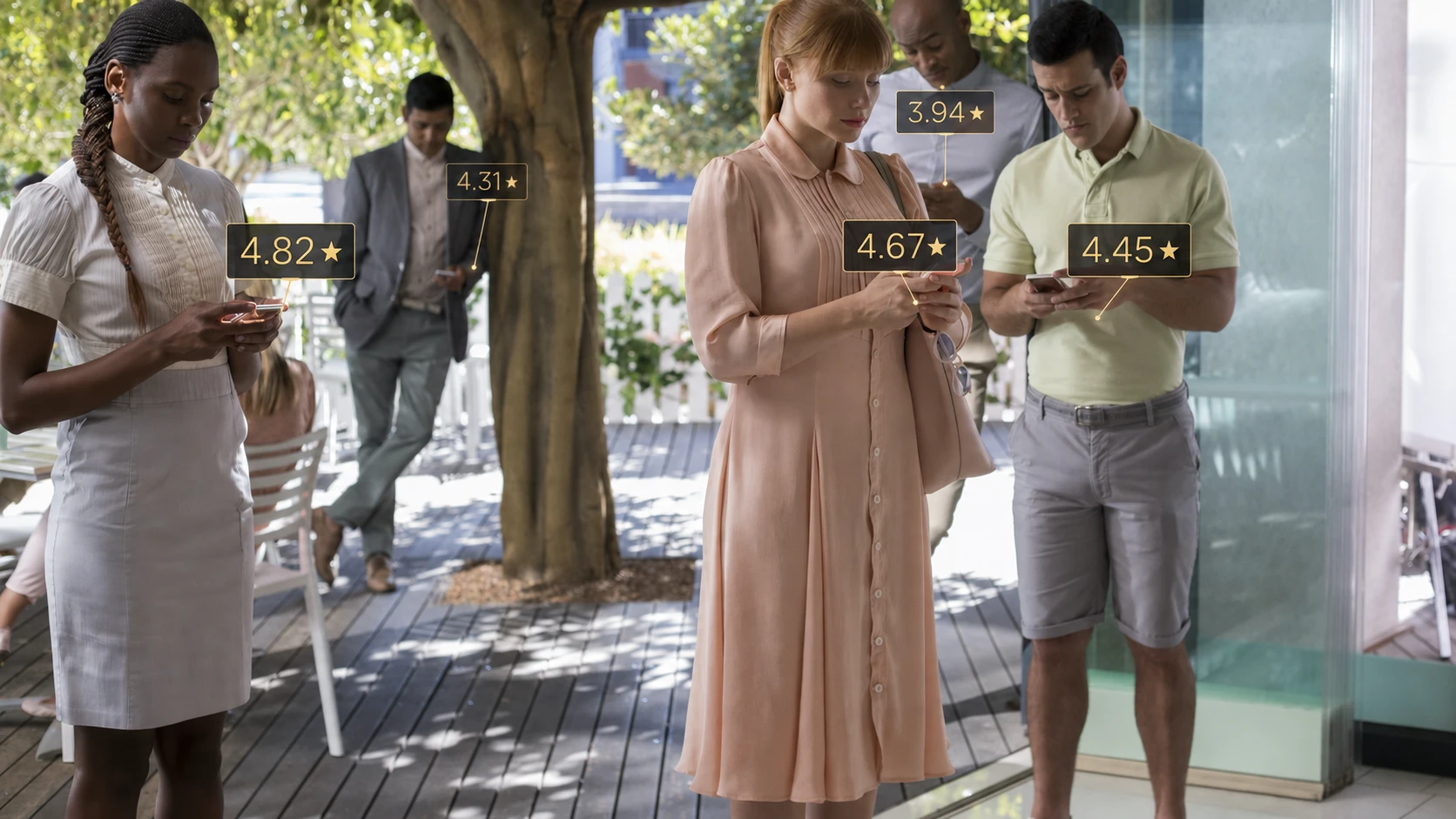
Nosedive imagines social value becoming explicit. The score follows each person around; everyone can see it; institutions act upon it; and people modify their behavior to improve it.
LinkedIn does not give you a professional score. In an important sense, it cannot. Too much of professional worth remains outside the range of what the platform can verify or encode.
It cannot determine whether a senior engineer has good judgment. It cannot reliably distinguish the brilliant founder from the well-networked one. It cannot see the disaster that never happened because someone competent was in the room, measure how rapidly a person is learning, or observe most private study. It cannot encode taste. It cannot tell whether someone with an impressive career is still becoming better or has spent ten years standing still.
LinkedIn therefore does not give everyone the tools to determine your professional worth. It gives everyone a standardized vocabulary for seeing part of it. Then it places millions of professionals inside the same environment, looking at one another through that vocabulary.
There is no single score to rebel against. There is only a frame that makes some facts easy to name and others difficult to display. What cannot easily be displayed appears less often in our picture of professional life. Spend enough time inside that picture and the boundary of the medium can begin to feel like the boundary of reality.
The promotion is real. The degree is real. The award is real. The prestigious employer is real. The frame is real too.
And some of the most important things about the person you are looking at may be happening just outside it.