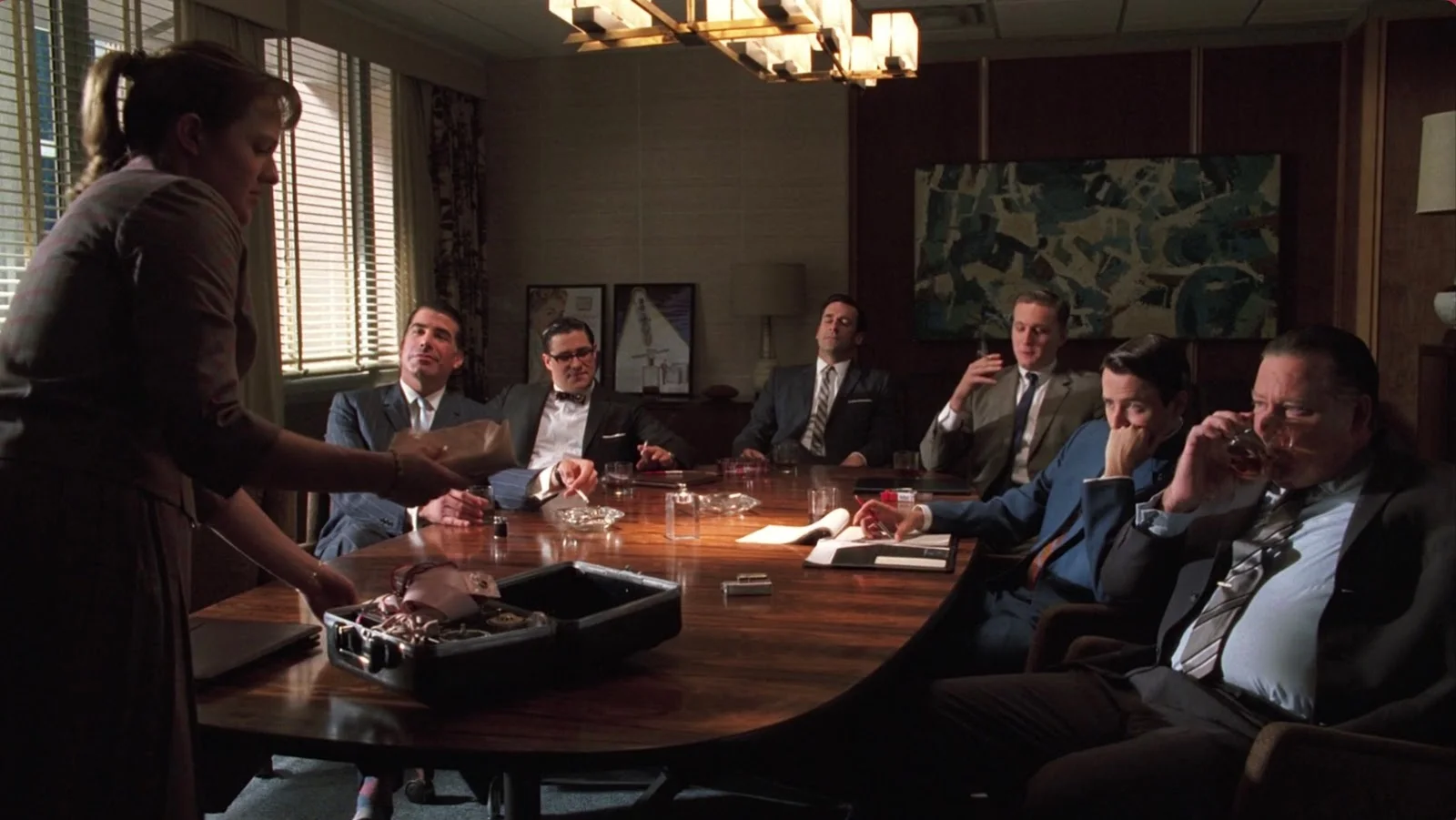
Joan Holloway and Lane Pryce occupy different positions on Sterling Cooper’s formal chart—and understand different sources of power.
There is a moment in Mad Men when John Hooker, the young British secretary serving Lane Pryce, describes Sterling Cooper as a “gynocracy”—a society ruled by women. Lane replies dryly: “Hadn’t noticed.”1
It is an absurd description on its face.
Sterling Cooper is unmistakably ruled by men. Men own the agency. Men occupy its executive offices. Men control its accounts and creative department. Men make the consequential decisions, earn the largest salaries, and enjoy freedoms unavailable to the women working beneath them.
Yet Hooker has noticed something.
The men may govern Sterling Cooper officially, but another organization exists underneath the one printed on the company directory.
The secretaries know who is sleeping with whom. They know whose marriage is deteriorating, which executive is unreliable, which client is furious, who called whom, who disappeared for lunch, and who must be handled delicately after a bad morning. They control calendars, telephone calls, correspondence, and access. Joan Holloway, despite lacking an executive title for much of the series, understands the human machinery of Sterling Cooper better than nearly anyone occupying its executive floor.
Hooker’s “gynocracy” is therefore more than a joke about women gossiping.
The first hierarchy is the one we acknowledge publicly.
It consists of titles, reporting structures, responsibilities, budgets, and decision-making authority. The CEO sits above the vice presidents. The vice presidents oversee directors. Directors manage teams. Employees receive job descriptions explaining what they are expected to do.
The second hierarchy is rarely written down.
It consists of trust, reputation, relationships, influence, access, loyalties, and information.
The formal hierarchy tells you who can approve something. The invisible hierarchy tells you whose approval actually matters.
Anyone who has spent enough time inside a large organization eventually discovers discrepancies between the two.
A director may technically possess authority over twenty people while having remarkably little influence over them. An employee several levels below an executive may be the person everyone consults before making an important decision. An administrative assistant may know more about the actual state of the organization than half of its management. Two departments that should cooperate seamlessly according to the organizational chart may barely trust one another.
These relationships are not incidental to the organization. Making them visible is part of effective strategy and systems work.
They are part of the organization.
This is where the distinction between gossip and social intelligence becomes important.
Gossip asks, What happened between those two?
Social intelligence asks, How does the relationship between those two affect what is possible here?
You do not need to know that John’s marriage is struggling. You may need to know that John trusts Maria, that Maria has the CEO’s ear, and that John becomes defensive when another department bypasses his team.
That is not trivia.
It is operational information.
Diagram 01
The Invisible Org Chart
Formal authorityInformal influence
Scroll to trace the network →
Figure 1The org chart tells you who is authorized to make a decision. The social network tells you whether that decision will survive.02 / Invisible Work
The Corporation Discovered the Work Joan Was Already Doing
Modern corporations have developed an impressive vocabulary for describing the invisible organization.
Stakeholder management
Cross-functional collaboration
Executive presence
Emotional intelligence
Organizational awareness
Managing up
Influence without authority
Stripped of their corporate euphemisms, these concepts describe an ability to understand human relationships and move effectively through them.
The engineer who produces technically correct work but repeatedly alienates the product organization may be judged less capable than an engineer of similar technical ability who can persuade product managers, designers, executives, and other engineers to move in the same direction.
The difference is not necessarily engineering ability.
The second engineer understands the invisible org chart.
In this sense, the contemporary corporation has formalized a category of work that Mad Men depicts as largely invisible and frequently feminine.
Joan does not merely answer phones and manage secretaries. She remembers relationships. She anticipates reactions. She knows who needs reassurance, who needs firmness, who should not be seated next to whom, what information should travel, and what information should remain where it is.
The men have authority.
Joan has organizational awareness.
Figure 2 Joan’s authority comes from knowing how the office actually works—who needs what, and when.
Sixty years later, corporations routinely list something resembling Joan’s skill set among the requirements for senior leadership.
03 / Social Architecture
The Corporation Was Built by Men. So Why Do Some Masculine Men Hate It?
There is a strange occupational pattern in American life.
Certain men who appear conventionally masculine—direct, independent, physically confident, resistant to interpersonal delicacy—seem considerably more comfortable in trades, transportation, construction, warehouses, military environments, and other task-oriented occupations than in corporate offices.
It would be easy to explain this as a difference in education or class.
But there may also be a difference in social architecture.
Consider two statements:
Left / Material judgment
That weld won’t hold.
Does it work?
→ Material reality determines outcome
Right / Social judgment
This strategy isn’t going to work.
Will they accept it?
→ Material reality + social network determine outcome
The same statement can carry different social costs.
They appear structurally identical. Someone has evaluated a piece of work and concluded that it is defective.
Socially, however, they can be radically different statements.
The weld will eventually encounter the physical world. It holds or it fails.
The strategy belongs to people.
Someone proposed it. Someone championed it. Someone may have spent six months developing it. A vice president may have publicly endorsed it. A team may understand criticism of the strategy as criticism of its competence. Another executive may secretly agree with you while being unwilling to contradict the person sponsoring it.
Suddenly, being correct is only the beginning of the problem.
You must determine when to say it, where to say it, to whom to say it, how strongly to say it, and who needs to hear it privately before it can safely be said publicly.
The stereotypically masculine response is:
Why can’t I just say what is true?
The corporate answer is:
Because saying something is also doing something to a relationship.
That difference explains a great deal of frustration with professional office culture.
A worker says something factually correct but insufficiently diplomatic and is told that he lacks communication skills.
He objects that nobody has demonstrated where his analysis was wrong.
They aren’t necessarily criticizing his analysis.
They are criticizing his ability to transmit that analysis through a human network without damaging the network.
04 / The Old Network
Men Created Office Politics Too
There is an obvious objection to the idea that corporate social maneuvering is somehow feminine.
The old corporation was extraordinarily political.
The country club mattered.
The golf course mattered.
Drinking with the boss mattered.
Fraternities mattered.
Military service mattered.
Knowing someone’s father mattered.
Being invited to the right dinner mattered.
A young executive’s career could depend on whether an older executive considered him “one of us.”
The famous old boys’ network was exactly that: a network.
Figure 3 The old corporation’s informal network operated through access, ritual, and belonging—not merit alone.
Men who succeeded in twentieth-century corporations were not simply walking into offices, announcing objective truths, and being rewarded according to merit. They cultivated alliances, managed reputations, deferred to superiors, mentored protégés, exchanged favors, guarded information, and learned elaborate codes governing what could be said to whom.
The corporate world did not suddenly become political when women entered it.
Perhaps something more interesting happened.
Corporate politics became less exclusively masculine.
The informal network expanded beyond the golf course.
Meanwhile, the economy itself changed. Manufacturing declined in relative importance. Services and knowledge work expanded. Organizations became less rigidly hierarchical. Projects increasingly required cooperation among people who did not report to one another.
The manager could no longer simply issue an order.
The modern professional increasingly had to influence without authority.
And when authority becomes weaker, relationships become stronger.
05 / Perception
The Less Visible the Work, the More Important the Story About the Work
There is another reason social intelligence has become so consequential.
Suppose a plumber repairs a pipe. The repair can be tested.
Suppose a truck driver is expected to deliver a shipment. The shipment either arrives or it does not.
Suppose a machinist manufactures a component within a specified tolerance. We can measure it.
Now consider a senior executive who claims to have “improved strategic alignment across the organization.”
How much alignment did she produce?
Or a product manager who “drove cross-functional execution.”
How much of the resulting product belongs to him?
Or a manager who “created a high-performance culture.”
Compared with what?
The further work moves from material output, the more difficult individual contribution becomes to observe.
And as objective measurement becomes harder, interpretation becomes more powerful.
Who is considered competent?
Who is considered difficult?
Who is considered a leader?
Who “drove” the project?
Who merely participated?
Who receives credit when the project succeeds?
Who becomes associated with its failure?
These are partly factual questions.
They are also social judgments.
This creates an uncomfortable possibility: in some knowledge organizations, managing the perception of one’s work can become nearly as important as performing the work itself.
At its best, this is leadership.
At its worst, it is theater.
06 / Manipulation
When Social Intelligence Becomes Social Manipulation
There is consequently a reason many people recoil from office politics.
The invisible organization can become pathological.
Social awareness becomes reputation management.
Diplomacy becomes euphemism.
Relationship-building becomes coalition-building.
Private conversation becomes whisper campaigning.
Emotional intelligence becomes the ability to identify precisely which emotional buttons to push.
A sufficiently skilled political operator can sometimes accumulate considerable organizational power while producing surprisingly little.
This creates a difficult problem for anyone who values directness.
Refusing to participate entirely does not make the invisible organization disappear.
It merely makes you less capable of perceiving it.
The answer is therefore not to become more manipulative.
It is to become more observant.
There is a profound difference between knowing people’s vulnerabilities and understanding people’s relationships.
You do not need everyone’s secrets.
You need to notice who trusts whom.
Who speaks freely around whom.
Who gets consulted before decisions.
Who can disagree without consequence.
Who becomes unusually quiet when a particular person enters the room.
Who gets copied on an email despite having no obvious reason to be there.
Who calls you immediately after the meeting.
Who introduces people.
Who protects people.
Who can make something happen without possessing the formal authority to make it happen.
This is the information contained in the invisible org chart.
07 / Asymmetry
When Everyone Knows You Before They Meet You
The internet introduces another complication.
Public visibility creates asymmetric social knowledge.
Diagram 02
Asymmetric Visibility
Scroll to trace the information →
Figure 4 One person enters the room with a name. The other enters with a dossier.
Before meeting someone, we can now know where he went to school, where he has worked, what he believes, what he has built, what he looks like, whom he knows, what he wrote five years ago, and perhaps what he ate last Thursday.
For anyone with even modest public visibility, this creates peculiar encounters.
You meet someone for the first time.
They may already know you.
Not personally, perhaps, but informationally.
They have searched your name. They have seen your work. They have formed an impression. They may have discussed you with someone else. They may know something about you that you do not remember making public.
Meanwhile, you know almost nothing about them.
The temptation is either to become suspicious or to compensate by researching everyone equally aggressively.
Neither response is particularly healthy.
A better form of social intelligence is privacy-aware observation.
Someone reveals that they know something about you that you never told them.
You do not necessarily need to ask how they know.
You can simply notice.
Interesting. They researched me.
That itself is information.
The socially intelligent person does not need to interrogate the room. He needs to learn how to read it.
08 / Power Flows
Social Intelligence Is Not Gossip
Perhaps this is ultimately what John Hooker recognized at Sterling Cooper.
He saw women exchanging information and interpreted the office as a “gynocracy.” But beneath the joke was an observation about institutional power.
The people who understand relationships possess a form of knowledge unavailable on the organizational chart.
That knowledge can be abused.
It can also be indispensable.
The mistake made by highly task-oriented people is assuming that relationships are somehow external to the work—that there is the real work, and then there are all the annoying human complications surrounding it.
But organizations are made of humans.
Trust determines which information travels.
Reputation determines which information is believed.
Relationships determine who cooperates.
Status determines who can contradict whom.
And culture determines which behaviors carry consequences that no employee handbook will ever describe.
The social network is not something wrapped around the organization.
The social network is part of the organization.
Learning to navigate it does not require becoming a gossip, a manipulator, or an amateur detective.
It requires learning to observe people with the same seriousness that we observe systems.
The official org chart tells you where authority resides.
The invisible org chart tells you where power flows.
Continue the conversation
Make hidden friction visible.
If relationships, roles, or unclear decision paths are slowing your organization down, we can help turn the invisible system into a structure people can use.